The Bible Speaks Today series is responsible for me getting interested in reading commentaries. The first one I bought was Michael Green’s volume on Matthew, which I then followed with Stott on Romans. Both were excellent and now I have read 51 (just 1 to go!).
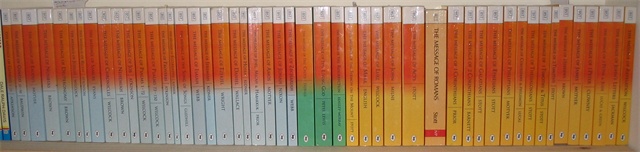
The Bible speaks today series has been slowly growing for almost 40 years and is now nearing completion, with just a couple of Old Testament books to go. (There is also a Bible themes series which has about 10 volumes) It is conservative evangelical in outlook, and therefore the books in question are understood in the light of the rest of the canon. The Old Testament in particular is viewed from a Christian perspective. They are in a fairly large paperback format, with a typical length of 200-300 pages.
The series benefits from two highly competent editors – Motyer and Stott (OT and NT respectively). They ensure that, in keeping with the series title, each volume is more about what Christians can learn from the book rather than being simply a ‘commentary’. Their judicious and even-handed editorship is evidenced by the remarkably broad spectrum of British evangelical leaders who have endorsed the series.
The authors are typically British Anglicans, and most are pastors rather than academics, although the writers are not lacking in scholarly expertise, and some have contributed to more technical series. Authors are frequently chosen for having preached a notable sermon series on the book in question to their own congregations. This makes the books often feel like a collection of expository sermons, and full of practical application.
They are designed to be accessible to all Christians who want to study a book in a bit more depth, and to this end the New Testament series has been furnished with a study guide, which offers a few (thankfully not patronising) questions on each chapter.
The books begin with a short introduction and bibliography, in which they will typically outline the main arguments for accepting the book’s historicity and traditional authorship. More important however, is the intention to communicate the biblical author’s main message, to demonstrate the continuing relevance of the book.
The commentary itself can vary dramatically in length. For example, Jeremiah is shorter than Jonah. Only two books (Genesis and Psalms) are covered in two volumes. In particular, some of the commentaries on the shorter NT epistles are quite long, and include treatment of issues covered by more intermediate level commentaries. Volumes on shorter books of the Bible will also typically include the biblical text. Most are based on the NIV, although some of the older ones use the RSV.
The authors are generally given freedom to make points on related issues such as ecology, the ecumenical movement, third world debt, infant baptism and so on. Where evangelicals are broadly agreed, they are forthright, and where evangelicals are divided, they are firm but never belligerent. The commentary is not always sequential either, with some sections being studied out of order, and in the case of Proverbs, approached thematically. You can expect the occasional key Greek or Hebrew word to be discussed, but no specialist vocabulary is presumed and it is always transliterated. They will not normally discuss the opinions of other commentators, but may well tie in current events.
This series is ideal for Christians who want to dig a bit deeper into a particular book of the Bible but find standard commentaries overwhelming and dull. Those looking for help preparing a Bible study on a passage will find it will provide plenty of ideas and insight.
The series is accessible but it’s not lightweight, and will perhaps still prove heavy-going for those who do not read non-fiction often. Slightly more readable series to try might be Tom Wright’s “For Everyone” series, or “Focus on the Bible” from Christian Focus. Alternatively, those looking for a bit more technical depth while retaining the evangelical and practical focus might want to try the Pillar (PNTC), Tyndale (TNTC, TOTC), New American (NAC) or NIV Application (NIVAC) series.
For me the series highlights are Leviticus (Tidball), Chronicles (Wilcock), Song of Songs (Gledhill), Ezekiel (Wright), Hosea (Kidner), Matthew (Green), Romans (Stott), Ephesians (Stott), 2 Timothy (Stott), and John’s Letters (Jackman). They have been most helpful for me in appreciating the main message of those books. I have reviewed a number from the series here on my blog:
- Genesis 1-11 (David Atkinson)
- Genesis 12-50 (Joyce Baldwin)
- Exodus (Alec Motyer)
- Leviticus (Derek Tidball)
- Numbers (Raymond Brown)
- Deuteronomy (Raymond Brown)
- Judges (Michael Wilcock)
- Ruth (David Atkinson)
- 1 & 2 Samuel (Mary Evans)
- 1 & 2 Kings (John Olley)
- 1 & 2 Chronicles (Michael Wilcock)
- Ezra & Haggai (Robert Fyall)
- Nehemiah (Raymond Brown)
- Esther (David Firth)
- Job (David Atkinson)
- Psalms 1-72 (Michael Wilcock)
- Psalms 73-150 (Michael Wilcock)
- Proverbs (David Atkinson)
- Ecclesiastes (Derek Kidner)
- Song of Songs (Tom Gledhill)
- Isaiah (Barry Webb)
- Jeremiah (Derek Kidner)
- Ezekiel (Christopher Wright)
- Daniel (Ronald Wallace)
- Hosea (Derek Kidner)
- Joel, Micah & Habakkuk (David Prior)
- Amos (Alec Motyer)
- Obadiah, Nahum & Zephaniah (Gordon Bridger)
- Jonah (Rosemary Nixon)
- Zechariah (Barry Webb)
- Sermon on the Mount (John Stott)
- Matthew (Michael Green)
- Mark (Donald English)
- Luke (Michael Wilcock)
- John (Bruce Milne)
- Acts (John Stott)
- Romans (John Stott)
- 1 Corinthians (David Prior)
- 2 Corinthians (Paul Barnett)
- Galatians (John Stott)
- Ephesians (John Stott)
- Philippians (Alec Motyer)
- Colossians & Philemon (Dick Lucas)
- 1 & 2 Thessalonians (John Stott)
- 1 Timothy & Titus (John Stott)
- 2 Timothy (John Stott)
- Hebrews (Raymond Brown)
- James (Alec Motyer)
- 1 Peter (Edmund Clowney)
- 2 Peter & Jude (Dick Lucas & Christopher Green)
- John’s Letters (David Jackman)
- Revelation (Michael Wilcock)
Jeremy Pierce has also reviewed James (Alec Motyer) and 1 Peter (Edmund Clowney).
11 comments